
The Bone Collector of the Blue Hole: Egypt's Most Deadly Dive Site
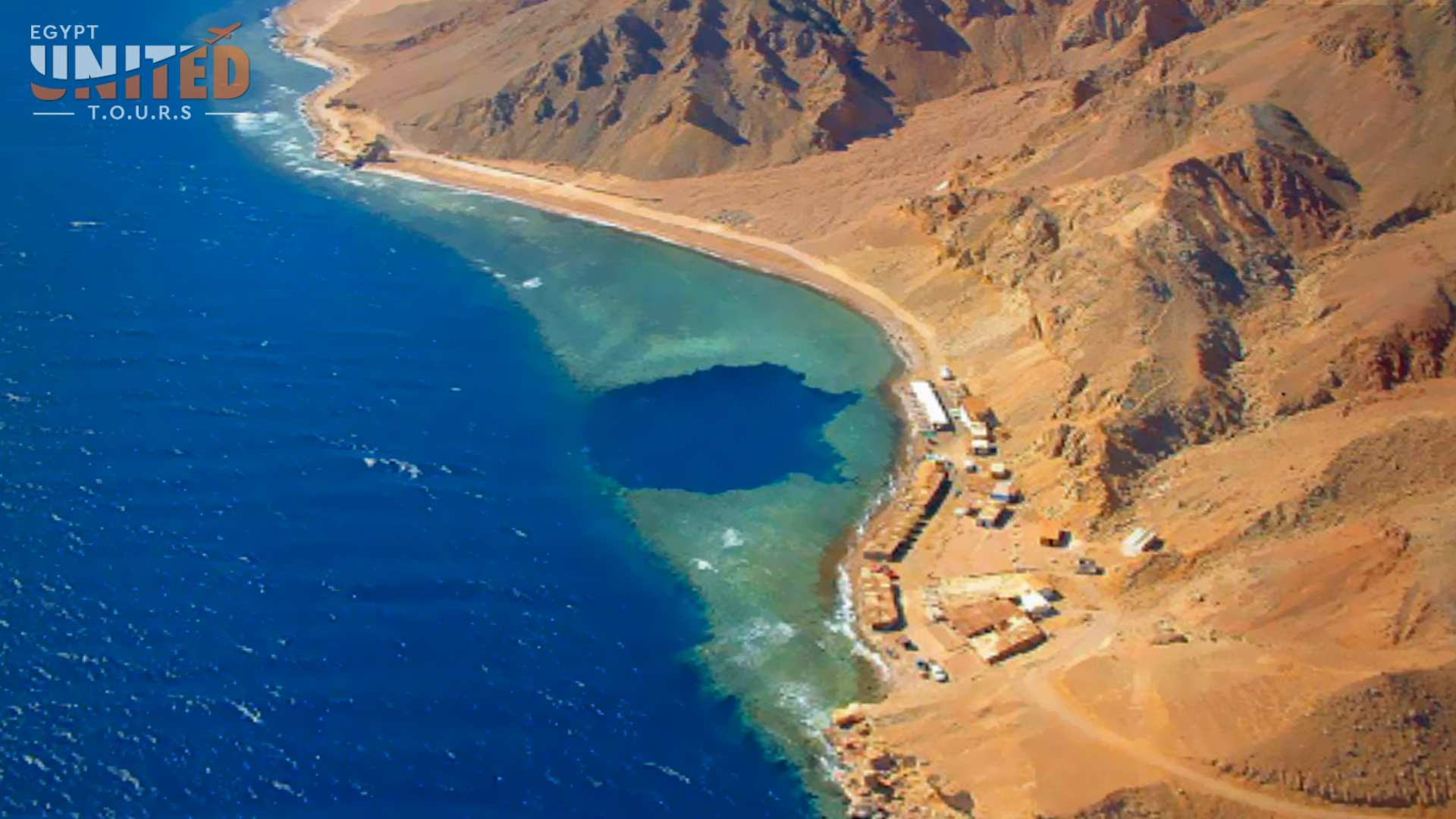
For thirty years, the Blue Hole off Egypt's Sinai Peninsula has claimed over 200 lives. One man has answered every call.
102 meters beneath the ocean's surface, the darkness is absolute. Even a torch beam travels barely two or three meters. The water is icy cold. Silence wraps around everything broken only by the sound of one man's breathing. His name is Tarek Omar. Slowly, he descends deeper into the sea. His torch cuts through the dark, and then he sees something.
Two human bodies lie on the seabed.

As he moves closer and shines his light over them, a haunting scene unfolds — one that remains etched in his memory to this day. Two young men, aged 22 and 23, lie locked in an embrace, as if sharing a final hug that even death could not break. Their oxygen regulators have slipped from their mouths and rest aside. Their eyes are open — but lifeless.
This was Tarek's first body recovery. November 1997. It would not be his last.
Nearly three decades later, he has lost count of how many times he has made that descent. Today, the world no longer knows him simply as Tarek Omar. He is known by another name: The Bone Collector.
This place is the Blue Hole a sinkhole off Egypt's Sinai Peninsula along the Red Sea coast. From above, its waters shimmer like gold. Beneath, however, it has claimed up to 200 lives over the past thirty years. Locals call it the "Diver's Cemetery."

At the entrance stands an old sign: Easy Entry Blue Hole. Thousands of divers read those words before entering. For more than a hundred of them, it became the last thing they ever saw.

Which raises an unsettling question: if so many have died here, why do people still come?
The Man Who Answers the Call
Tarek Omar arrived in Dahab in 1989 in search of work. By 1992 he had learned to dive; by 1995 he was a certified instructor. But everything changed in 1997, when he was called to perform his first recovery. Since then, whenever a life is lost in the Blue Hole, Tarek's phone rings.
He never charges for his service — only for equipment. He believes he shares a bond with the bodies he retrieves, and that it is his duty to bring them back to the surface.
Today, fourteen memorials stand along the cliffs of the Blue Hole. Each one marks a dive he has made.
The Lives It Has Taken
Martin Gara & Conor O'Regan — November 1997
Two Irish friends arrived in Dahab with a shared dream: to return home and start a travel agency built around overseas diving tours. Martin had been working in Egypt as a diving instructor for a year; Conor had just finished his economics degree at Trinity College Dublin. This trip was meant to be their trial run.
During a group dive, something went wrong. The two became separated in the darkness and descended beyond their safe depth. Their tanks were not designed for such pressures. Nitrogen narcosis set in. Their regulators slipped from their mouths, water filled their lungs, and they sank to 102 meters — where they remained, locked in an eternal embrace, until Tarek brought them home.
Yuri Lipski — April 28, 2000
A 22-year-old diving instructor who had long dreamed of swimming through the Blue Hole's famous underwater arch. Despite warnings from Tarek and other locals, Yuri descended alone — equipped with a camera rated only for 75 meters, excessive weights, and a tank filled with ordinary compressed air.
The footage he recorded shows the water gradually darkening as he sinks past 40 meters, then 80, then beyond. At 115 meters, disorientated and believing he was ascending when he was actually sinking further, he crashed onto a ledge. His buoyancy device failed under the pressure. In his final moments, he removed his own regulator.
The camera recorded the last 6 minutes and 53 seconds of his life.
Igor Shalov — 2011
An experienced diver with over 400 dives to his name, attempting a descent to 150 meters. On his way back up, he skipped essential decompression stops. The rapid pressure change caused nitrogen bubbles to form inside his body — a condition known as decompression sickness. He surfaced in agony and died within minutes.
Stephen Keenan — 2017
A respected Irish safety diver, assisting Italian freediver Alessia Zecchini on an arch-crossing attempt. A delay of just 20 seconds proved fatal. Disoriented by currents, Alessia struggled to ascend. Stephen found her and guided her upward — but at the cost of his own oxygen supply. Alessia survived. Stephen did not.

Why the Blue Hole Kills
The answer lies in its depth, its structure, and the illusions it creates. Formed as a sinkhole in limestone, the Blue Hole features sheer vertical walls dropping to 130 meters. At around 55 meters lies the arch — a tunnel leading out to the open sea. The water's extraordinary clarity makes the arch appear far closer than it actually is, luring divers into a deceptive trap.

At depth, nitrogen dissolves into the bloodstream and dulls the brain. Divers call it the "martini effect" — each additional 10 meters feels like another drink. Confusion sets in at 30 meters, poor judgment at 40, disorientation at 50. At around 60 meters, some divers remove their own regulators, convinced they no longer need to breathe.
Disorientation, hallucinations, and human error do the rest.
Some divers claim to hear strange sounds in the depths. Locals speak of a restless spirit a young girl said to lure divers, especially men, to their doom. But science offers a simpler explanation: extreme conditions distort perception, and the human mind fills in the gaps.
Tarek himself dismisses the myths. In his experience, it is not spirits but nature — and human mistakes — that claim lives here.
And Yet, People Continue to Come
Because the Blue Hole is beautiful. Because challenge attracts. Because some believe they are the exception.
But the truth is, the Blue Hole spares no one.
And when the mind itself begins to fail, survival becomes nearly impossible.