
Upanishad Reader Is Live: Read the Upanishads Verse by Verse in 12 Indian Languages
ॐ असतो मा सद्गमय | तमसो मा ज्योतिर्गमय
Lead me from untruth to truth, from darkness to light.
We are delighted to share the Upanishad Reader. It is a free website where you can read the Upanishads in your own language. Visit it at upanishads.vibemotive.com.
The Upanishads are very ancient and profound texts. They contain some of the biggest questions we can ask ourselves. Who am I? What is real? And who is the silent observer behind my thoughts? However, many people struggle to read them because the original texts use Sanskrit. Also, it can be difficult to find accurate translations in regional languages. So we created this website to help.
What does Upanishad mean?
The word Upanishad comes from Sanskrit. It has three parts: upa (near), ni (down) and shad (to sit). So it means "sitting down near", like a student who sits close to a teacher to learn the deepest truths of life. The Upanishads come at the end of the Vedas. For this reason, people also call them Vedanta, or "the end of the Veda". They talk about the Self (Atman) and the Ultimate Reality (Brahman). They also show how a person can come to know the truth about life.
Why we created this
I am Shibasis Rath from VibeMotive, and I created the Upanishad Reader. I dedicate this project to my grandfather, Shri Godabari Rath. He is a disciplined and honest man who served in the police department. He is also a priest and astrologer, and he lives his life with faith and love for God. From him, I learnt that true strength and spirituality go hand in hand. So this small gift is for him. I hope every word brings you some peace, clarity and courage on your self-discovery journey.
I come from a science background, but I have always loved spirituality. I am not a scholar, and I do not claim to know everything about the Upanishads. Instead, what I know comes from different books and from what my grandfather taught me. So this website is a way for me to learn along with you and to share these ideas in a simple way.
Read in your language
When you visit for the first time, the reader asks you to select your language. You can change it at any point. You can choose from 12 languages. Also, we have created every Upanishad in full detail in all of them, so you can read the meaning in the language you know best.
| Language | Script |
|---|---|
| English | English |
| Hindi | हिन्दी |
| Sanskrit | संस्कृतम् |
| Odia | ଓଡ଼ିଆ |
| Bengali | বাংলা |
| Tamil | தமிழ் |
| Telugu | తెలుగు |
| Kannada | ಕನ್ನಡ |
| Malayalam | മലയാളം |
| Marathi | मराठी |
| Gujarati | ગુજરાતી |
| Punjabi | ਪੰਜਾਬੀ |
What you can do
The reader shows each Upanishad one verse at a time, so you can read slowly and reflect on each line. For each verse, you see the Sanskrit mantra and its meaning in your language. Four tabs at the top of the page help you find your way. Home shows the featured Upanishad, your progress and a list of all the Upanishads.

Read shows the verses, and Savedshows your favourite verses. Finally, Explore lets you filter the Upanishads by Veda, Theme or Mantra. You can filter by Veda (Rigveda, Krishna Yajurveda or Shukla Yajurveda). You can also sort the list alphabetically, by Veda or by number of verses.


The Home page also shows how much progress you have made. For example, if you stop at verse 1 of 16 in the Akshamalika Upanishad, you see a progress bar and a "Continue reading" card. Just tap it to carry on where you left off. We designed the reader to work well on mobile devices, so you can simply swipe to move to the next Upanishad. Besides this, you can save your favourite verses, and you can read without internet.
A few extras
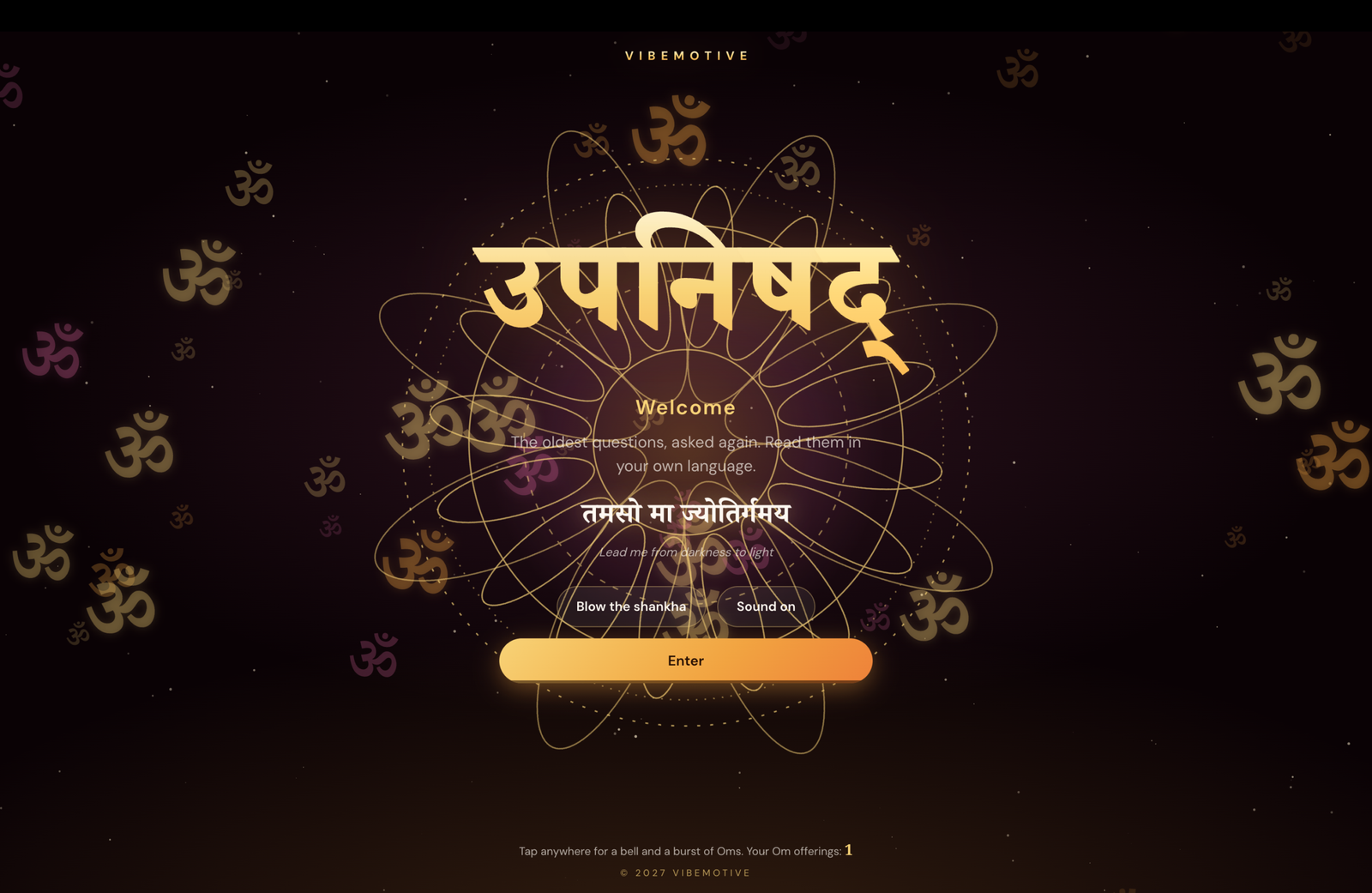
If you are unsure what to read, tap the dice icon and the reader opens a random Upanishad. Then use the search icon at the top to find what you need. Use the Aa settings to make the text easy to read. The Home page also shows a Seeker's Reflection to take with you through your day, for example "Who is the quiet witness behind my thoughts?" A link next to it takes you to related Themes and Mantras. When you arrive, a welcome screen appears with the sound of the shankha (conch).
Before you begin, you can read a short intro about the Upanishads. It shares what great people like Swami Vivekananda, Dr. Sarvepalli Radhakrishnan, Rabindranath Tagore, Arthur Schopenhauer, Max Müller and Dara Shikoh said about them. You will also find a publisher's note and information about the symbols and abbreviations we use.
What can I read today?
We are not adding all the Upanishads at once. Instead, we add one Upanishad a day, and we create each one in full detail in all the regional languages. Right now, you can read three.
Akshamalika Upanishad (Rigveda) talks about the sacred rosary (akshamala). It also explains the 10 components of the rosary, the 3 strings, the blessing of the letters from A to Ksha and the spiritual benefits of using it.

Akshi Upanishad (Krishna Yajurveda) tells how Sage Sankriti learns the Chakshushmati Vidya (a prayer for protecting the eyes) from the Sun god. Then he learns the 7 stages of Yoga that lead to the realisation of Brahman.

Advaya Taraka Upanishad (Shukla Yajurveda) is our newest Upanishad. It teaches Taraka Yoga, the yoga of the inner light between the eyebrows. It also explains the 5 types of Akasha (space), the 2 types of Taraka (murta and amurta), Shambhavi Mudra, the signs of a true Guru and the benefits of realisation.

List of Upanishads
This is the full list of Upanishads. You can read the first three now. After that, we add new Upanishads one at a time, every day, with full details in all 12 languages. So come back every day to see the next one!
| No. | Upanishad |
|---|---|
| 1 | Akshamalika Upanishad (Available) |
| 2 | Akshi Upanishad (Available) |
| 3 | Advaya Taraka (Adattadara) Upanishad (Available) |
| 4 | Kali-Santarana Upanishad |
| 5 | Kalagnirudra Upanishad |
| 6 | Krishna Upanishad |
| 7 | Ganapati Upanishad |
| 8 | Garuda Upanishad |
| 9 | Gayatri Rahasya Upanishad |
| 10 | Gopala Purvatapini Upanishad |
| 11 | Chaturveda Upanishad |
| 12 | Jabala Upanishad |
| 13 | Tuladi Upanishad |
| 14 | Dipropanishad |
| 15 | Dakshinagnimurti Upanishad |
| 16 | Dakshinamurti Upanishad |
| 17 | Deva Upanishad |
| 18 | Dhyanabindu Upanishad |
| 19 | Narayana Upanishad |
| 20 | Nilakantha Upanishad |
| 21 | Nrisimha Purvatapini Upanishad |
| 22 | Nrisimha Chakra Upanishad |
| 23 | Pashupata Brahmana Upanishad |
| 24 | Pranagnihotra Upanishad |
| 25 | Bahvricha Upanishad |
| 26 | Bhavana Upanishad |
| 27 | Maha Upanishad |
| 28 | Yogakundali Upanishad |
| 29 | Yogachudamani Upanishad |
| 30 | Yogaraja Upanishad |
| 31 | Radha Upanishad |
| 32 | Rama Purvatapini Upanishad |
| 33 | Rudrahridaya Upanishad |
| 34 | Rudrakshajabala Upanishad |
| 35 | Rudrakshi Upanishad |
| 36 | Langula Upanishad |
| 37 | Linga Upanishad |
| 38 | Saraswati Rahasya Upanishad |
| 39 | Sarvasara Upanishad |
| 40 | Saubhagyalakshmi Upanishad |
| 41 | Saubhagya Upanishad |
| 42 | Surya Upanishad |
Who is this for?
The Upanishad Reader is for students and seekers who want to read the Upanishads verse by verse, with the original Sanskrit and its meaning. It is also for families who want to share this heritage with their children in their mother tongue. Finally, it is for anyone who wants a moment of peace, because even one verse can help.
Get started today
Click the link below to get started with the Upanishad Reader. It is completely free to use. Also, please share it with a friend or family member who might enjoy a moment of peace today.
We are human and still learning. So if you spot any errors, missing translations or anything that does not look right, please forgive us. We would love to hear from you! Send us an email at risingkingdom00@gmail.com, and we will carefully make the changes.
With love and gratitude,
Shibasis Rath, VibeMotive
एकं सद्विप्रा बहुधा वदन्ति
ॐ शान्तिः शान्तिः शान्तिः
With the Blessings of Shri Godabari Rath